Montessori Mar del Sur

viernes, 23 de octubre de 2015

Huevos de Mariquita // Ladybird eggs


Tuvimos la suerte de encontrar huevos de mariquita. Los encontraron las niñas en el envés de unas hojas de árbol.Ya vimos el ciclo de vida de la mariquita en este otro post. // We were lucky to find ladybird eggs. The girls found it on the underside of a leaf. We saw the Ladybird Cycle stage of life in this other post.
Como veis tiene mucha similitud con el de plástico.
En el otro post podéis descargaros las tarjetas del ciclo de la mariquita. // As you can see it is equal to the plastic one. In the other post you can download the cards of the ladybird cycle stage of life.
A ver si tenemos suerte y vemos nacer a las mariquitas // We hope to be lucky and see the ladybirds growing up.
¡Feliz Enseñanza Montessori! // Happy Montessori Schooling!

lunes, 19 de octubre de 2015

Juego del punto // Montessori Dot game

¡Hola a tod@s, después del verano!, y ya en ¡Otoño! Hemos vuelto a retomar el trabajo,  ya que nos mudamos de nuevo y acabamos de terminar de desempaquetar todo. Volvimos a plegar el mapa de España y regresamos al sur. En la nueva casa adaptaré el salón, para tener un lugar de trabajo más confortable y espacioso.
Así que iremos reanudando las presentaciones y los post poco a poco. Me queda bastante trabajo, y este año después del curso AMI de introducción a Primaria (Taller), afrontamos los nuevos objetivos con muchísima ilusión y ganas.

Y os presento el juego del punto. En este ejercicio se trabajan las sumas de más de dos sumandos, llegando los resultados a las decenas de millar.
Estos son folios, pero podéis comprar esta tabla para operaciones matemáticas . // 

Hi everybody after summer and welcome Fall! We moved again and have come back to the south. We are still unpacking, but we started to do some work. In this house we will work in the biggest living-room, to be more confortable. We will start with the presentations and the post. It is going to be hard but after the AMI introductory Taller Training, I feel quite confortable to reach the goals. 
And this is the Montessori dot game, we work here the addition operations with more than two addends, so we arrive to the ten thousands.
 We use paper but you can buy also this mathematic operation board.
Otra operación matemática.  // Another mathematic operation
Aquí podéis ver con más detalle como las llevadas se anotan en el recuadro encima del resultado. // Here you can see how we write down the dynamic addition in the box on top of the results.
¡Feliz Enseñanza Montessori! // Happy Montessori Schooling!

lunes, 29 de junio de 2015

Tarjetas de figuras sólidas del gabinete geométrico // Solid figure cards of the Geometric Cabinet.

¡Y llegó el verano!, seguimos trabajando pero más tranquilamente. Compaginamos el trabajo con la playa, excursiones, camping, piscina....etc. Tengo mucho trabajo atrasado, poco a poco iré publicando lo que estamos trabajando.  // Summer is here!, we are still working but in a relaxed way...We work but also we go to the beach, we do excursions, camping, swimmingpool..... I have a lot of work behind, so I will post as soon as I can...


Sofía sigue trabajando con el gabinete geométrico, hemos introducido las primeras tarjetas del gabinete geométrico, que son las tarjetas con las figuras sólidas del primer cajón, círculos. En esta otra entrada podéis ver como trabajamos anteriormente con el gabinete. // Sophie is working with the geometric cabinet, we presented the first cards of the geometric cabinet which are the solid figure cards of the first drawer, circles. In this previous post you can see how we worked previously with the geometric  cabinet.
  

Segundo cajón, cuadrado y rectángulos // Second drawer, square and rectangles.
 También introducimos las tarjetas sólidas del segundo cajón // We also presented the solid figure cards of the second drawer.
 Y emparejamos // and we match up.
 Tercer cajón, triángulos // Third drawer... triangles
 Y presentamos las tarjetas de su correspondiente cajón // And we made the presentation of the cards of its own drawer.
 Después de presentar las tarjetas de las figuras sólidas, pasaremos a presentar las tarjetas de los contornos anchos... // After we made the presentation of the solid figure cards, we will continue by presenting the width edge cards...
 ¡Feliz Enseñanza Montessori! // Happy Montessori Schooling!

lunes, 18 de mayo de 2015

Avanzando en Geografía...// Improving the Geography...

Nos encanta la Geografía, ¡así que a trabajar!,
Sacamos nuestro mapa puzzle y la plantilla correspondiente. // We love Geography so get on with it!
We set our puzzle map and its own stencil.

Con el mapa de África // Puzzle map of Africa
 Oceanía // Oceania
 América del Sur // South America
 Asia // Asia
Además de los mapas también utilizamos estas tarjetas con las formas de la Tierra para emparejar los accidentes geográficos. Buscamos dónde están situados los accidentes geográficos más significativos, como el Golfo de México, la Península de Arabia, los Grandes Lagos.....//  We work with these landform cards on top of the puzzle maps. We search where are the most significant geographical features like the Gulf of Mexico, Arabian Peninsula, Great Lakes....
 Y aquí seguimos trabajando los accidentes geográficos, utilizando el gabinete de las formas de la tierra y las tarjetas de las formas de la Tierra de lija// we continue working with  the landform cabinet and the the sandpaper geographical feature cards.
 Este es de los trabajos favoritos de Sofía... // This is one of the Sofia's hit.

 En el mapa de Europa situamos los países... // We set the country labels on the Europa's puzzle map.
 Estas tarjetas están en castellano, ya que en las plantillas vienen en inglés. // These cards are in Spanish, because on the stencil the country names are written in English.
Y pasamos a registrar los nombres de los países en inglés y castellano. // So we write down the country names in English and Spanish.
¡Feliz Enseñanza Montessori! // Happy Montessori Schooling!


viernes, 15 de mayo de 2015

Nivel Blanco. Introducción Alfabeto Móvil // Wall sound letters and the Movable Alphabet

Y seguimos trabajando el nivel blanco. Aquí está Sofía trabajando el sonido de la letra "l" y el sonido de la letra "t". // We continue working the sound wall letters, this time the sound of letter "l" and "t".

 Os comparto este Papel pautado para trabajar la escritura.//  I share this draw lines on paper to work the handwriting.
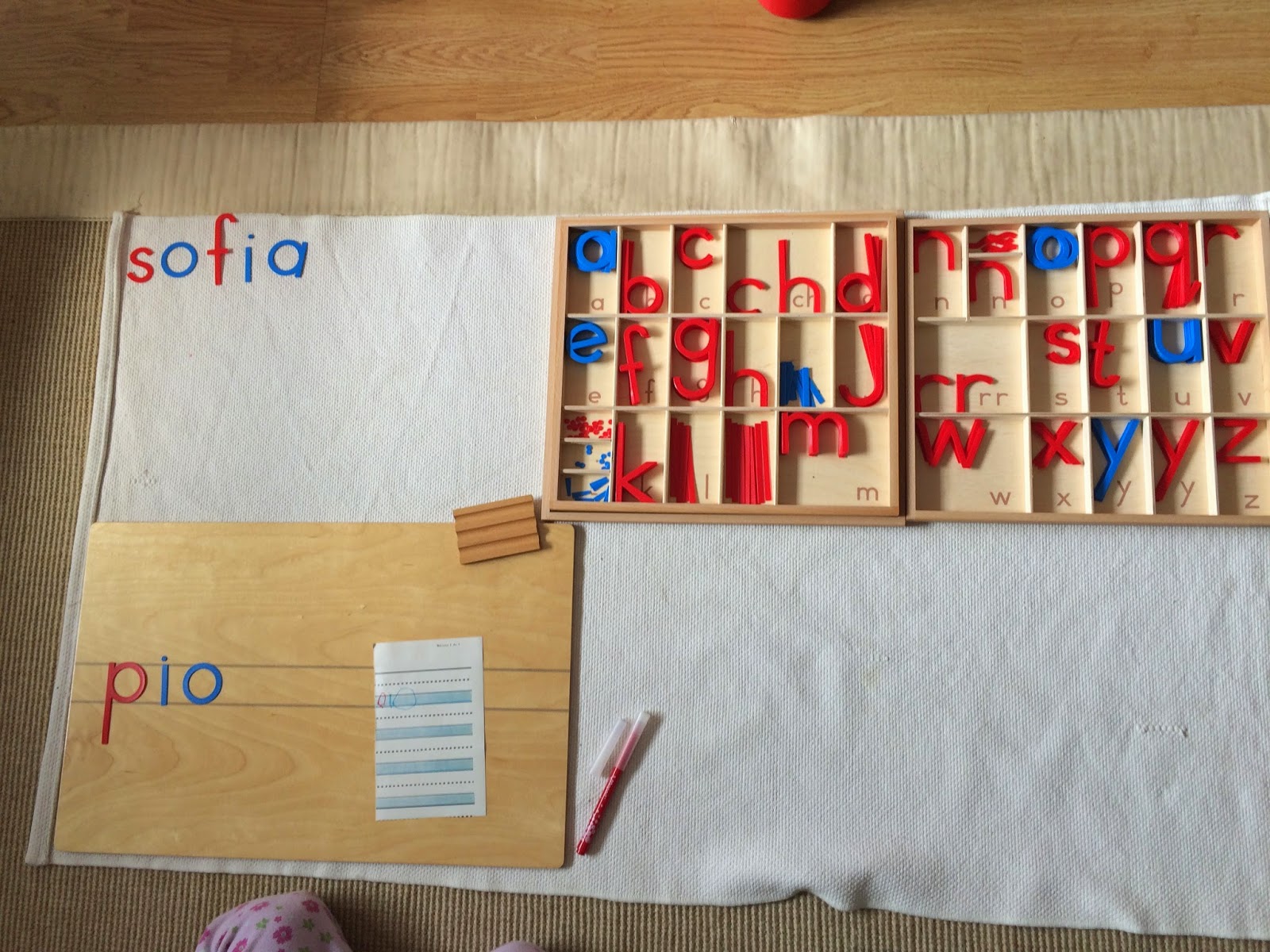
Introducción del alfabeto móvil con letras de lija.  // We introduced the movable alphabet with the sand letters
Escribimos palabras de tres letras // We write words of three letters
Sofía quería saber cuales eran las mayúsculas de estas letras....o como ella las llama, las mámas y las hijas... // Sofía wanted to know which ones were the capital letters of these letters...she call them mothers and daughters...
¡Feliz Enseñanza Montessori! // Happy Montessori Schooling!

martes, 12 de mayo de 2015

Simetría // Symmetry

 Trabajamos la Simetría y empezamos por definirla: Se conoce como Simetría axial a la simetría que existe entorno a un eje cuando la totalidad de los semiplanos que se toman desde una determinada mediatriz exhiben las mismas características. // We worked Symmetry and we started defining it: 
Axial symmetry is symmetry around and axis; an object is axially symmetric if its appearance is unchanged if rotated around an axis (perpendicular bisector).


Y para descifrar esta definición....Trabajamos el concepto de simetría a través del  arte, para ello dividimos nuestro folio en dos partes iguales, (que serían nuestros semiplanos). El doblez será nuestro eje de simetría (mediatriz). Dibujamos a un lado de nuestro eje. Luego plegamos la parte del folio en blanco (semiplano), sobre el dibujo, y queda el dibujo impreso en los dos lados del eje. //  To decipher the definition...we worked through Art. Fold the paper in two. Draw in one side, then fold again to print the draw on the other side of the axis.

Y si seguimos con la definición... Se considera simetría cuando los puntos que pertenecen a una figura son coincidentes con los puntos que forman parte de otra figura, tomando a modo de referencia el eje de simetría ( una línea). // The correspondence in size, shape, and relative position of parts on opposite sides of a dividing line or median plane or about a center or axis.

Hay cientos de ejemplos de simetría en la naturaleza...// There are a thousand of symmetry examples in nature.
Y muchos recursos para trabajar la simetría en internet. A mí particularmente me gustan estos puzzles de madera, y también estos ejercicios matematica1.com // There are thousand of symmetry resources in internet.  I love these wooden puzzles, and also these kind of exercises from matematica1.com
De esta manera la simetría axial supone un fenómeno similar cuando un espejo refleja una imagen.
 Utilizamos un espejo pequeño para dibujar el reflejo. Nuestro espejo es nuestro otro plano axial, y a la vez nuestro eje de simetría. // So symmetry is the same phenomenon as when we see one image and its reflection in a mirror.We use a small mirror to draw its reflection. Our mirror is our axis.
 Comprobamos que la imagen del espejo es igual a la dibujada...// We check that our draw is the same as the image in the mirror...
¡Feliz Enseñanza Montessori! // Happy Montessori Schooling!

miércoles, 29 de abril de 2015

Botánica. Estudio de las partes de una flor // Botany. Studying the Parts of a flower

 Preciosa primavera. Nos encantan las flores, el sol, los árboles en flor....
Así que aprovechamos para estudiar las partes de una flor. // Beautiful Spring. We love the flowers, the sun, the in bloom trees... So we studied the parts of a flower.
La plantilla la descargamos de Creciendo con Montessori y utilizamos el puzzle de la flor//We downloaded the stencil from Creciendo con Montessori and we worked with the flower puzzle.
Colocamos las partes del puzzle en la plantilla, y averiguamos cómo se llaman cada una de las partes de la flor.// We set the puzzle parts on the stencil, to know the name of the parts of the flower.
Cortamos una flor para ver de cerca los estambres y pistilo. // We cut a real flower to see in more detail the stamens and the pistil.
El polen. // The pollen
Otra de las flores que nos acompañan esta primavera // Another flower which is growing at home.
Una preciosa abeja libando de una flor, justo enfrente de casa. Hablamos sobre la polinización y la función tan importante que hacen las abejas en la naturaleza. // A beautiful bee sipping a flower, just in front our house. We talked about pollination and why the bees are so important in nature.

¡Feliz Enseñanza Montessori!// Happy Montessori Schooling!

martes, 21 de abril de 2015

Más sobre los triángulos constructivos // More about the Constructive triangles.

Seguimos con la caja número 1 de los triángulos constructivos. En esta foto podéis ver el trabajo de investigación que ha realizado Paula, clasificando los triángulos según la longitud de sus lados.

Para la clasificación de los triángulos según sus ángulos utilizamos El círculo de ángulos y fracciones. Este es un triángulo escaleno rectángulo.//
To classify the triangles by its angles, we use the Fractions and angles circle.  This is a right scalene triangle.
Este es un triángulo escaleno obtusángulo // This is an obtuse scalene triangle.
Que son los dos triángulos que componen un trapecio. // The trapezium is formed by these two triangles.
Siguió con la investigación de la clasificación de los triángulos. Midió todos los lados de los triángulos para hallar los que eran equiláteros, isósceles o escalenos. // She continued investigating the triangles classification. She used the ruler to measure the sides of the triangles, to know which one was equilateral, isosceles or escalene.


Para medir los ángulos también podemos utilizar el Protractor, que se utiliza para medir en grados los  ángulos de los círculos de las fracciones. Se suele vender junto con el Marco centesimal, que también se utiliza con las fracciones para demostrar cómo las fracciones se pueden reducir a decimales //  To measure the angles we can use the Protractor which is used with the Fraction Circles to demonstrate how angles are measured in degrees. It usually comes with the Centesimal Frame used with the Fraction Circles to demonstrate how fractions may be reduced to decimal.
 

Aquí un triángulo obtuso // Here an obtuse triangle.
 Y aquí un triángulo equilátero acutángulo // Here an acute equilateral triangle.
¡Feliz Enseñanza Montessori! // Happy Montessori Schooling!